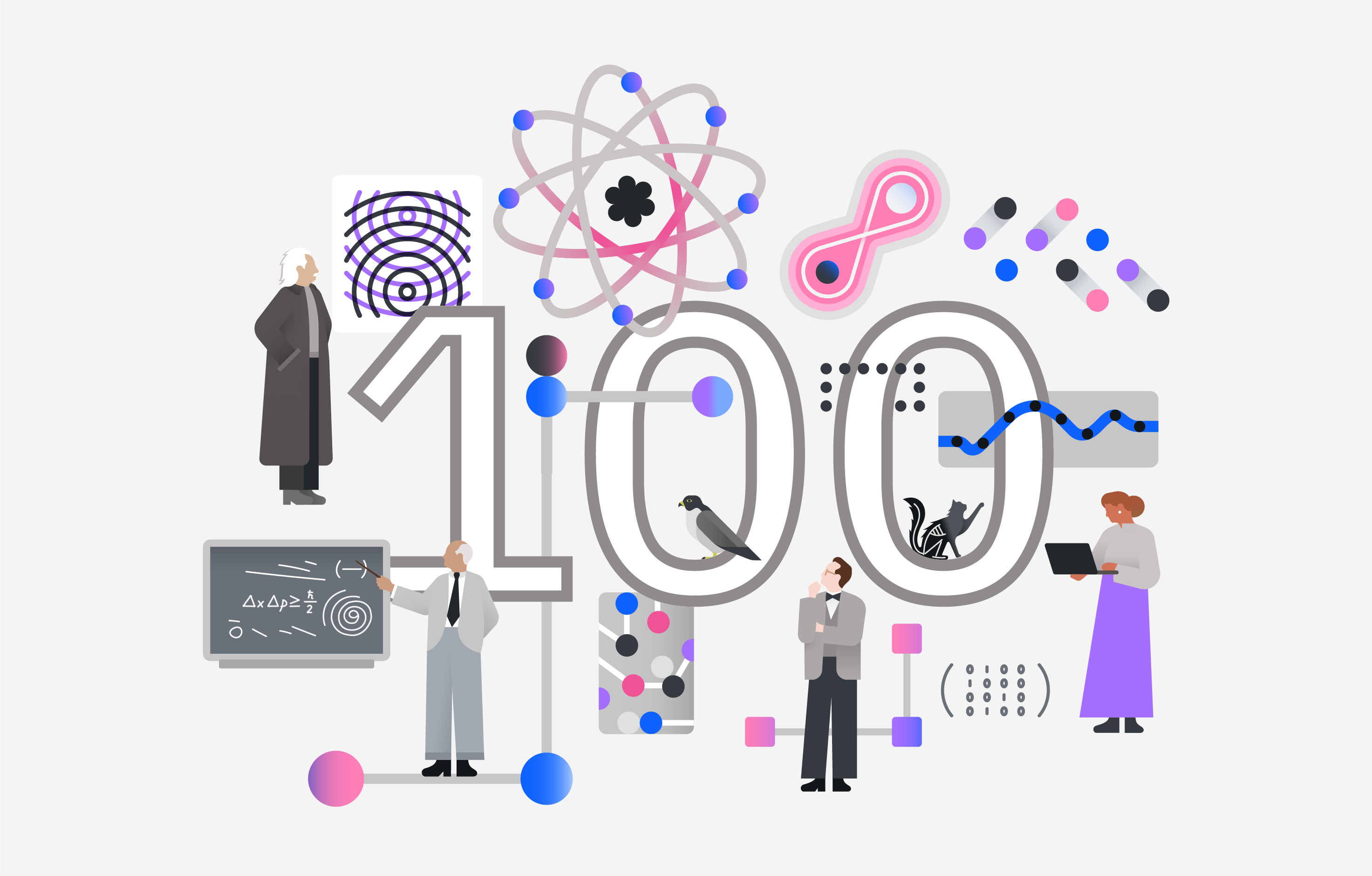





From the birth of quantum theory to today's quantum computers, explore the revolutionary discoveries that shaped our understanding of the quantum world.
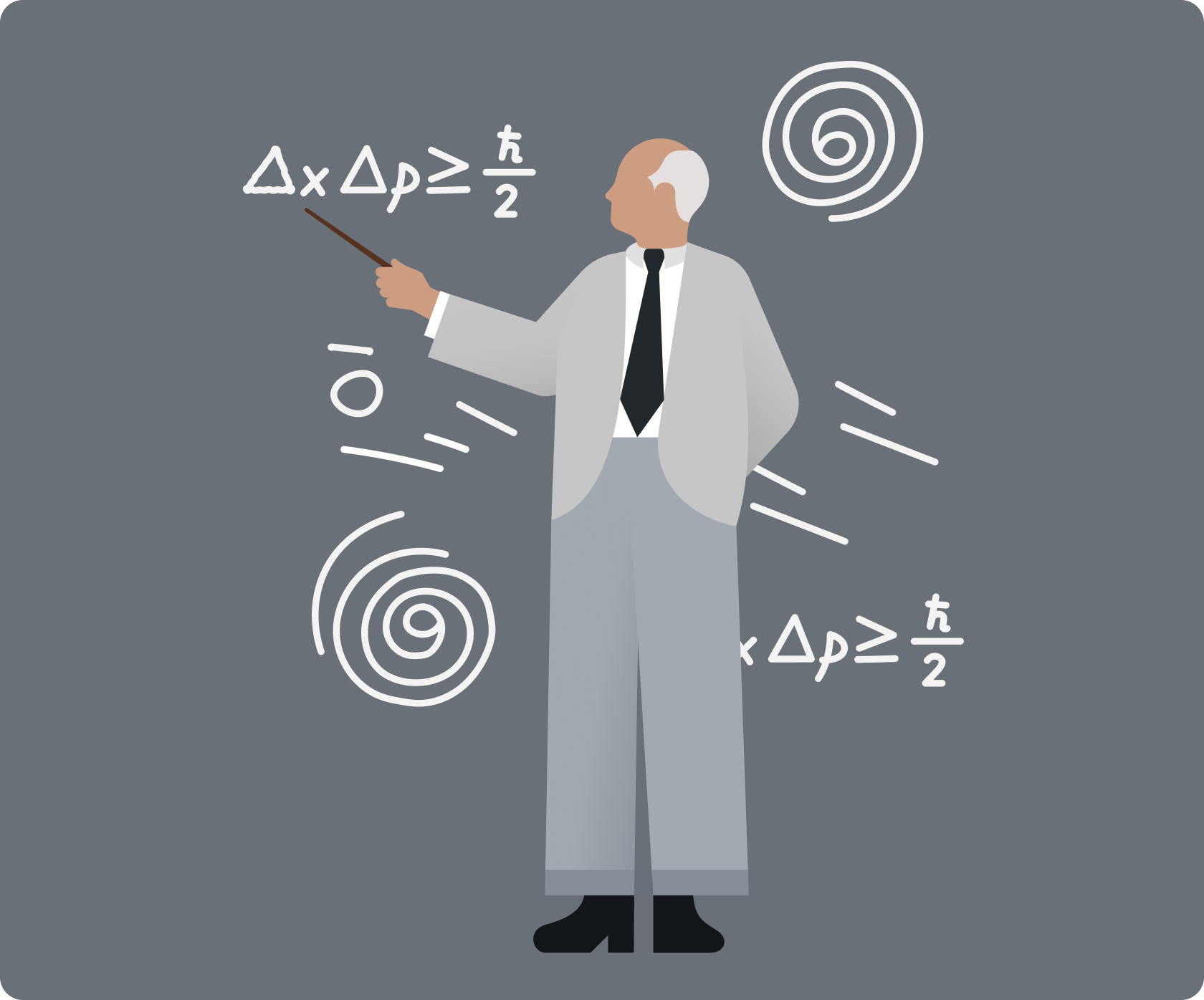
Werner Heisenberg formulated the first complete mathematical framework for quantum mechanics, introducing the famous uncertainty principle that bears his name.
Foundation of Modern Quantum Theory
Erwin Schrödinger developed wave mechanics and his famous equation that describes how quantum systems evolve over time, revolutionizing our understanding of atomic behavior.
Mathematical Foundation of Quantum States
Niels Bohr introduced the concept of complementarity, stating that particles can exhibit both wave-like and particle-like behavior depending on the experimental setup.
Wave-Particle Duality Resolution
Einstein, Podolsky, and Rosen challenged quantum mechanics with their paradox, inadvertently discovering quantum entanglement - the "spooky action at a distance."
Foundation of Quantum Information
The invention of the transistor at Bell Labs marked the beginning of the semiconductor revolution, enabling modern computers and quantum devices.
Birth of Semiconductor Technology
John Bell's theorem provided a way to test quantum mechanics against local hidden variable theories, experimentally confirming quantum entanglement.
Experimental Validation of Quantum Theory
The development of laser cooling and trapping techniques allowed scientists to control individual atoms, opening doors to quantum simulation and computation.
Single Atom Manipulation
Peter Shor's quantum algorithm demonstrated that quantum computers could factor large numbers exponentially faster than classical computers, threatening RSA encryption.
Quantum Advantage Proven
IBM researchers demonstrated the first quantum computer capable of performing simple calculations, marking the beginning of practical quantum computing.
First Functional Quantum Computer
Today, we stand at the threshold of practical quantum computing, with IBM Qiskit leading the way in making quantum accessible to researchers, students, and developers worldwide.
Democratizing Quantum ComputingQuantum mechanics revolutionized our understanding of matter, energy, and the fundamental nature of reality at the smallest scales.
From lasers and transistors to MRI machines and GPS systems, quantum principles power the technologies that define our modern world.
Quantum computers promise to solve complex problems in cryptography, drug discovery, optimization, and artificial intelligence.
Quantum communication and networking will enable ultra-secure information transfer and distributed quantum computing.
From theoretical foundations to practical applications, quantum mechanics has evolved into cutting-edge technologies that are transforming our world.
Superconducting qubits, trapped ions, and photonic quantum computers are pushing the boundaries of computational power, with IBM's quantum processors leading the charge.
Quantum key distribution (QKD) and post-quantum cryptography are revolutionizing cybersecurity, making communications unhackable by quantum computers.
Atomic clocks, quantum magnetometers, and gravitational wave detectors are achieving unprecedented precision in measurement and navigation.
Quantum simulations are accelerating drug discovery, materials science, and chemical research by modeling molecular interactions at the quantum level.
Quantum teleportation and entanglement distribution are laying the foundation for a quantum internet that will enable ultra-secure, high-speed global communication.
Quantum algorithms for machine learning promise exponential speedups in data analysis, pattern recognition, and artificial intelligence applications.
Particles can exhibit both wave-like and particle-like behavior depending on how we observe them.
Particles can be instantaneously connected, sharing properties regardless of distance.
We cannot simultaneously know both the position and momentum of a particle with absolute precision.
Particles can exist in multiple states simultaneously until measured.
Particles can pass through energy barriers that would be impossible in classical physics.
Waves can constructively or destructively interfere, creating probability patterns.
As we commemorate 100 years of quantum mechanics, Qiskit Fall Fest 2025 embodies the spirit of those pioneering scientists.
Just as Einstein, Heisenberg, and Schrödinger shared their discoveries, we're democratizing quantum education for the next generation.
Building a worldwide community of quantum enthusiasts, researchers, and developers to tackle tomorrow's challenges.
Fostering the same curiosity and innovation that drove the quantum pioneers to explore the impossible.
Be part of the quantum revolution that began 100 years ago and continues today with IBM Qiskit Fall Fest 2025.